

Executive summary
B2B buying is non-linear, stakeholder-heavy, and experience-driven, which makes client journey design a critical differentiator for revenue teams. B2B buyers expect connected, personalised, omnichannel engagement long before they ever speak to sales. Organisations that meet these expectations see stronger pipeline predictability, higher conversion rates, and faster growth.
Effective client journey design rests on four practices:
- Build personas grounded in real buyer behaviour, validated with intent data and account-level activity, not assumptions
- Activate insights by integrating CRM, behavioural, firmographic, and technographic data into a unified journey view
- Align marketing, sales, and client success (CS) around shared goals and a single buyer narrative across every touchpoint
- Operationalise a journey model that adapts to buyer intent in real time, accommodating non-linear stakeholder paths and the dark funnel
Establish client journeys that meet buyers where they are, guide them with relevance, and convert interest into revenue.
B2B client journeys begin in the dark funnel, where buyers research solutions independently before ever interacting with sales. This makes discoverability, relevance, and trust more critical than ever. To offer great client journeys, organisations must not only ensure prospects can find the right information but also demonstrate credibility across multiple channels.
However, the end of the journey is equally important, as retention has become an increasingly crucial initiative. According to the INFUSE Voice of the Buyer 2026 report, only 26% of buyers report being “very satisfied” with their current vendors and 48% are “somewhat satisfied.” Many remain open to switching as trust and post-purchase value become decisive factors in long-term partnerships.
Successfully navigating this era of B2B requires a strategic combination of insights, personalised engagement, and coordinated experiences that smoothly guide buyers from awareness to long-term retention.
What is a client journey in B2B?
A client journey refers to the complete process that a business professional takes as they convert from a prospect to a buyer, to a client. It encompasses all touchpoints and experiences, from the initial awareness stage to post-purchase interactions.
Unlike B2C journeys, B2B client journeys typically involve longer decision cycles, buying groups with diverse priorities, and a more complex set of interactions across channels and stakeholders.
How B2B client journeys are evolving
What is the difference between client journeys and buyer journeys?
A B2B buying journey covers the path from initial problem awareness through research, purchase, and ongoing engagement. Much of this happens independently, with 61% occurring in the dark funnel (6sense, 2025).
Client journeys also include the post-purchase phase, including onboarding, service delivery, support, retention, and advocacy. In short, the B2B buying journey spans awareness to purchase, while the client journey extends this to the experiences that keep clients satisfied after they buy.
Aspect
Buyer journey
Client journey
Primary focus
Steps leading from initial problem awareness to purchase
Includes experiences after purchase that drive satisfaction and loyalty
Key stages
Awareness → Consideration → Evaluation → Purchase
Onboarding → Adoption → Support → Renewal → Advocacy
Who it involves
Prospects and buying committees researching solutions
Existing clients, users, and account stakeholders
Primary goal
Help the prospect make a confident, informed purchase decision
Ensure long-term success, renewals, expansion, and advocacy
Team ownership
Marketing + Sales
Client Success + Product + Marketing
Success KPIs
Conversion rate, pipeline velocity, win rate
NRR, CSAT, adoption, retention, advocacy
How are client journeys evolving?
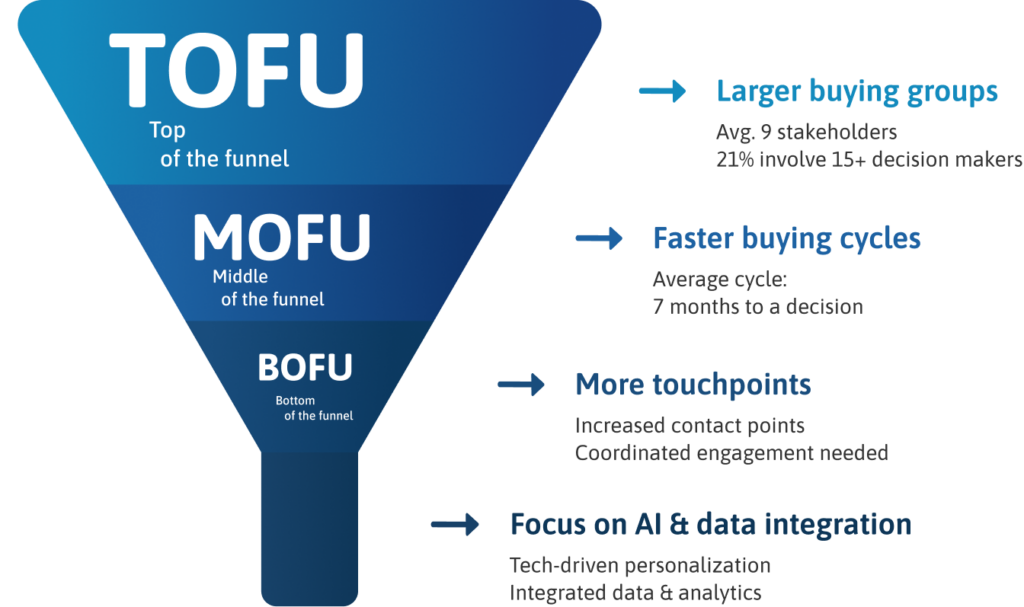
B2B client journeys are shifting as buyers become more independent, with higher expectations for quality, value, and personalisation. Buying groups are large, averaging nine stakeholders, with 21% involving 15+ decision makers (INFUSE Voice of the Buyer 2026). At the same time, sales cycles are shortening to take around seven months.
These changes increase touchpoint volume and complexity, requiring coordinated messaging, strong data systems, and personalised content for diverse stakeholders. With 95% of purchases coming from the day one shortlist (6sense, 2025), organisations must build trust and positive experiences early.
Technology and data optimisation are even more essential, with Forrester (2025) reporting that data integration and personalisation-at-scale rank amongst the top B2B marketing investment priorities.
How B2B client journeys are evolving


Larger buying groups

21% involve 15+ decision makers

Faster buying cycles
7 months to reach a decision


More touchpoints
Coordinated engagement is needed

Focus on AI and data integration
Integrated data and analytics
Why is client journey mapping important?
Client journey mapping is essential for demand generation as it helps understand the full path from initial awareness to a satisfied client. Strong client journey mapping also improves marketing and sales performance by identifying stall points, high-impact touchpoints, and the content that supports evaluation at each stage.
By understanding these journeys, businesses can identify pain points, personalise interactions, and deliver more relevant content. This increases engagement, trust, and conversion. Aligning marketing with client needs strengthens demand strategy, deepens relationships, and drives revenue growth.
According to a 2025 Deloitte study, client-obsessed organisations achieve 41% faster revenue growth and 49% faster profit growth due to stronger retention and advocacy.
4 benefits of successful client journeys
Building client journeys successfully drives measurable performance gains for B2B organisations. Below are the top four impacts on critical KPIs.
1. How do client journeys enhance the client experience?
Developing effective client journeys remains a critical element of enhanced B2B client experience. Organisations are focused on understanding buyer needs and expectations to create personalised interactions across all touchpoints, which results in deeper trust and lasting loyalty.
How can I enhance client experience with client journeys?
By designing journeys that anticipate buyer expectations, organisations provide intuitive, continuous, and well-orchestrated experiences.
Research from the Financial Times (2025) shows 85% of key stakeholders view trust as a competitive advantage, while the 6sense Buyer Experience report (2025) finds that 61% of the purchasing process occurs before buyers engage sellers, highlighting the need for cohesive early-stage experiences.
2. How do client journeys improve client retention, brand perception, and client success?
Successful client journeys strengthen retention by establishing trust and satisfaction from the first contact through delivery. Positive experiences make clients feel valued, creating loyalty and reducing the likelihood of switching providers.
How can I improve client retention and brand perception?
By delivering consistent, positive experiences, organisations make interactions feel less transactional and more value-driven, demonstrating a long-term commitment to client success.
Satisfied clients are not only more likely to stay loyal but also to recommend your organisation to peers, enhancing brand perception and building advocacy. This combination of trust, reliability, and demonstrated value strengthens retention and supports sustainable, long-term relationships.
3. How do client journeys drive higher conversion rates and ROI?
Well-structured journeys help identify bottlenecks, optimise processes, and align interactions with client needs and pain points. This reduces drop-offs, improves efficiency, and drives higher conversion rates and revenue.
How can I drive higher conversion rates and ROI?
Organisations taking a relational, insight-driven approach are seeing stronger performance gains as AI becomes a catalyst for scale and precision. INFUSE Voice of the Buyer 2026 shows buying cycles have accelerated to seven months, while buying groups now average nine stakeholders. This makes coordinated, intelligence-led journeys essential.
When deployed correctly, AI enables teams to personalise engagement at this expanded scale, reduce friction across touchpoints, and strengthen post-purchase loyalty by ensuring every stakeholder receives relevant information throughout the end-to-end client experience.
4. How do client journeys enable data-driven decision making and optimal resource allocation?
Client journeys generate actionable insights that support informed decisions and efficient use of resources. Behavioural data helps tailor services and optimise team efforts, budgets, and time.
How can I enable data-driven decision making and optimise resources?
By applying AI and analytics, organisations identify improvement opportunities and allocate resources where they deliver the greatest impact.

How to build effective client journeys: 7 best practices
Crafting effective client journeys requires a combination of data, strategy, and innovation.
Below are seven best practices to deliver exceptional experiences that result in lasting client relationships.
1. Develop in-depth buyer personas
A thorough understanding of target audiences and accurate buyer personas is crucial to crafting a smooth and effective client journey.
How to develop buyer personas in 5 steps
The foundation of creating an accurate buyer persona includes the following steps:
- Conduct research: Gather data through surveys, interviews, and buyer group research to understand your buyer’s preferences and behaviours
- Identify patterns: Analyse the collected data to identify common demographics, interests, and challenges in your prospect
- Create persona profiles: Develop fictional representations of your typical clients, including their goals, pain points, and preferred communication channels
- Validate with real data: Test and validate the personas using actual client behaviour, survey feedback, and social listening. Using demand intelligence here allows you to apply intent data, account-level activity, and in-market signals to prioritise and refine your targeting
- Inform marketing strategies: Tailor your marketing efforts to address the specific needs and preferences of each persona
Continuously update your personas using real data and insights, not assumptions, to ensure they remain accurate and relevant. Collaboration across marketing, sales, client success, and product teams aligns everyone on who your key buyers are and how they make decisions.
Prioritising high-value personas allows you to focus resources where they have the greatest impact, and regularly measuring performance helps refine and iterate your strategies based on what is working.
2. Use data and analytics for B2B journey insights
Gaining clear B2B journey insights through data is integral to crafting effective client journeys. Data delivers valuable insights into client preferences, behaviours, and pain points.
When creating a client journey, gain complete insight through a combination of quantitative, qualitative, firmographic, and technographic data.
Importantly, these insights should be applied to guide decision making, inform personalised messaging, prioritise high-value accounts, and shape the types of experiences offered at each stage of the journey.
When utilising data, keep the following best practices in mind:
- Define clear objectives: Outline specific goals for data and analytics usage in client journey development
- Collect relevant data: Gather data from sources like CRM systems, social media, and client feedback
- Segmentation and personalisation: Divide your client base into segments based on demographics, behaviour, and preferences
- Integrate data sources: Combine data from different sources to form comprehensive client profiles and understand their omnichannel journeys
- Predictive analytics for insights: Use predictive analytics to anticipate client behaviour, preferences, and pain points
- Real-time monitoring: Implement real-time analytics to track client interactions
- A/B testing for optimisation: Test different strategies, messages, and experiences to optimise the client journey
3. Take an omnichannel approach to B2B journey orchestration
Integrating a wide range of marketing channels to deliver a consistent experience is essential for crafting effective client journeys. Prospects interact with brands through diverse platforms, making it essential to maintain a cohesive brand identity and messaging across channels. This fosters trust, recognition, and a seamless user experience, ultimately enhancing client loyalty and retention.
Organisations must also recognise the diverse channel preferences of different buying group roles and client personas. By employing multi-threading, which engages multiple stakeholders across different channels simultaneously, organisations can ensure their content reaches the right people at the right time. Doing so increases relevance and resonance.
Recognising that engagement is not linear is also crucial. Clients often traverse a non-linear path, jumping between channels and touchpoints. By synchronising efforts across platforms, brands provide a holistic journey that adapts to clients’ evolving needs and behaviours.
4. Establish collaboration across marketing, sales, and client success
Effective client journeys require tight alignment between marketing, sales, and client success teams. This synergy ensures a consistent narrative from the initial touchpoint to post-purchase, enhancing client engagement and trust.
Below is an example of how each team aligns:
- Marketing teams craft compelling messages
- Sales tailors conversations accordingly
- Client success fosters excellence in service
The following best practices can be implemented to ensure clear alignment:
- Establish shared goals: Ensure that teams understand and share common goals for a unified vision
- Open communication: Foster open and transparent communication between teams to bridge gaps and build trust
- Prospect qualification and scoring: Establish a clear scoring and qualification process for a smooth marketing-sales handoff
- Joint campaigns and content creation: Sales and client success teams can provide real-world insights into client pain points, objections, and frequently asked questions, which can be used to create effective marketing materials
- Regular cross-functional meetings: Meet frequently to discuss ongoing initiatives, share successes, and address challenges
5. Establish a streamlined client journey mapping process
- Map your client journey from awareness to purchase, then optimise it continuously
- Use data-driven insights to identify touchpoints, personalise interactions, and anticipate client needs
- Implement omnichannel nurturing while ensuring a frictionless experience across devices and platforms
Hyper-personalisation and segmentation can help you deliver relevant messaging to the right prospects at the right time, acknowledging that buyers often move non-linearly through their decision process.
6. Create relevant, valuable content
To effectively engage clients, content should be intentionally designed to inform, inspire, and drive meaningful action throughout the entire journey.
- Mix content formats like articles, case studies, videos, webcasts, and interactive tools
- Use AI and analytics to tailor content to client segments, while maintaining authenticity and human insight
- Encourage client participation through co-creation, interactive demos, and success stories to deepen engagement and build trust
7. Provide consistent engagement
Sustained client relationships are built through ongoing, thoughtful interaction that evolves with their needs and behaviours.
- Develop meaningful connections with clients across all channels
- Use insights from client behaviour to inform communication timing and tone
- Encourage social proof, thought leadership, and community-building initiatives to convert satisfied clients into advocates
- Continuously test, measure, and refine each element of the journey to respond to evolving client expectations and industry trends
The key is to combine personalisation, seamless cross-channel experiences, and compelling content so clients can engage on their own terms. This makes the path from prospect to loyal customer intuitive, responsive, and conversion-driven.
Key takeaways
- Engage early and often: B2B buyers move through long, non-linear, multi-stakeholder journeys, making personalised, omnichannel engagement essential for capturing intent early and influencing the Day One shortlist.
- Use real data: High-performing organisations anchor their client journeys in real buyer data and predictive insights that enable timely, relevant interactions across every touchpoint.
- Align cross-functionally: Effective journeys require cross-functional alignment, with shared goals, unified messaging, and a consistent brand experience.
- Test, measure, and refine: Companies that continuously test, measure, and refine their journeys see stronger pipeline predictability, higher conversion rates, and better client relationships.

READY TO CONNECT WITH YOUR NEXT BUYER THROUGH SMARTER CLIENT JOURNEYS?
Our INFUSE demand experts are available to help craft personalised client journeys specific to your target audiences, which incorporate impactful demand generation strategies that drive your growth.